Thursday, 14 March 2013

For the Wellbeing


Report by: Nisha Poulose, March 11, 2013 

for 

FRIENDS OF TIBET FOUNDATION FOR THE WELLBEING
Friends of Tibet
Friends of Tibet Foundation for the Wellbeing, PO Box 16674, Bombay 400050, India.
Email: wellbeing@friendsoftibet.org Web: www.friendsoftibet.org/wellbeing


The whole report you find here: 
http://www.friendsoftibet.org/wellbeing/reports/wellbeing_mar_2013.html

Alexander Devasia and Sylvie Bantle of Sylviander House Art Museum, Alleppey who created an image identity

The Wellbeing image identity was created by Alexander Devasia whose relationship with nature and his own spirit is holistic and untainted. He connects to his soul and has a deep respect for nature and hence proved to be the perfect person to create the image identity of the Wellbeing programme.

We asked Alexander Devasia and Sylvie Bantle, long-time supporters of Tibet cause for a statement and these were the beautiful words they had to share:

"Wellbeing means a healthy nature! When I am sitting on my veranda surrounded by nature drawing everything that surrounds me — in the East the two blossoming cashew nut trees with yellow and red fruits, in the West the garden with the lotus pond and biotope — I forget myself and become one with this beauty. Humans can hunt and go fishing, harvest the fields and control the world. As more modern life goes on, we forget about keeping a space alone for the nature as our ancestors in Kerala did with a "kavu" near the house or the village. Everything could co-exist there — creatures and plants which were not of much use for the people, trees and creepers without tasty fruits or animals like snakes, beetles and mosquitoes … The Kavu was the spiritual corner of the place where people lived. They must have understood that their life without nature would not be possible.
I cannot think to live without nature around me, without all this variety of beings — I am a part of it. I share my life with these birds, butterflies, fish, frogs and turtles in the pond, the two squirrels on the roof, three wild cats in the garden and all the different trees — I am not getting tired of drawing the character of their leaves and blossoms … And every morning when I see everything in the light of sunrise again and again, I receive my first medicine of the day by inhaling the power of nature. She is the mother of all life, in health I will enjoy wellbeing for soul and body."

<B>Alexander Devasia, one of the prominent contemporary Indian artists draws out the Image Identity for the Friends of Tibet Wellbeing Programme from Sylviander House, an Art Museum and Gallery he runs at Alappuzha in Kerala with his wife Sylvie Bantle. (Photo: Sylviander Art Museum)

Alexander Devasia, one of the prominent contemporary Indian artists draws out the Image Identity for the Friends of Tibet Wellbeing Programme from Sylviander House, an Art Museum and Gallery he runs at Alappuzha in Kerala with his wife Sylvie Bantle.
Alexander Devasia, one of the prominent contemporary Indian artists draws out the Image Identity for the Friends of Tibet Wellbeing Programme from Sylviander House, an Art Museum and Gallery he runs at Alappuzha in Kerala with his wife Sylvie Bantle. (Photo: Sylviander Art Museum)

Nisha Mary Poulose is a Bangalore-based researcher and architect who specialises on Urban Development and Planning. She is also a part of the Design & People network of volunteer architects. Nisha Poulose can be reached at: nisha.poulose@designandpeople.org

Sunday, 3 March 2013

Geckoes – sun bathing & beer drinking!


Yes, here comes the story about sun bathing and beer drinking geckoes in the Sylviander House! 


I knew, geckoes live in trees and in houses beside the people. 
How many of them do live in the Sylviander House we couldn‘t manage yet to count. But we observed while sitting on the veranda, that each one has its own area strictly prohibited to others. Sometimes we can watch their fights, then they are chasing away another one trying to catch beetles and flies in an occupied place on the wall. 


To live with geckoes surprises with quite some unexpected sceneries. 
Did you know, that geckoes like sun bathing? 
I didn‘t, until I saw a tiny baby geckoe on the window-ledge beside my writing table laying there for more than one hour without any movement. 
After taking photographs and then enlarged in my computer I was really amazed about the surface of the skin, which I never saw with my eyes. 


For shure you didn‘t know, how much geckoes love beer! 
I came to know because of our lazyness to wash the glasses right after having a beer in the evening. We just had put them on the washing place with the plan to clean next morning. When I came back before going to bed I saw two geckoes sucking the beer drops from our glasses. 


That happened every evening after having had a beer, why we deliberately went on keeping our glasses unwashed beside the washing place, happy for having now a good reason: sharing our pleasure with the geckoes. 


One evening, I just opened a beer bottle when I got the compassionate impulse to pour a sip into the lit for the little beer lovers. Later then I carefully creeped with the camera in my hand to the spot and there he was! Of course the beer drinking gecko was to busy to run away – just had a short look at me and then went on to enjoy the beer. 
Cheers! 

(written by Sylvie Bantle)


Tuesday, 26 February 2013

2. Children Class

Saturday 17.February 2013, 3 p.m. 

Actually it was a student class. DTPC – District Promotion Tourist Council – had organised a 2 days training camp for students and teachers. The last day of this training camp was a 2 hours cultural programm in the Sylviander House Art Museum. Around 60 students came with their teachers. 


After the welcoming the visitors and a short introduction of Sri C.Pradeep (DTPC Secretary Alappuzha) and Sri Venu Gopal (Kerala State Tourism Club Chief Coordinator), Alexander talked about his vision since his student‘s time to open an Art Museum in a village one day in his future, about his need to paint and to draw, about his current exhibition »Water, the Mirror of the World«. 


Before starting my talk I suggested sitting down with me on the wooden floor for being closer in a dialogue atmosphere with all the listeners. Asking about their impressions of the paintings it was good to hear how strongly the message of the paintings were corresponding with the people. 
To get into the deeper meaning of Alexander‘s exhibited paintings, each filled with so many raindrops, it was necessary to have a look at the complexity of water as we did similiary in our 1st Children Class in January. 

A discussion followed mixed in Malayalam and English full of questions and ideas about water‘s liveliness, the communication of the water in our body and in our surrounding, how it exchanges information wether negative or positive. The quality of water we drink and have around us depends on humans attitude, noise and pollution will give such a negative information, that it won‘t show crystals as it does in springs untouched by humans or respected. Even polluted water can create beautiful crystals after rituals and prayers. 
This imagination gave a lot of input for change in thinking about our daily live. What does this mean for us, for our health physically and mentally, what does this mean for our society culturally? 
Such questions hopefully will help to develope awareness in future.

To complete our gathering we all stood up for giving respect to the poet Vinaya Chandren who recently died. After a silent contemplation some of his poems Ajaya Kumar sang for us with his expressionful voise. 

Finally our german guest Laura, who stays with us for 1 month, played guitar and all together we sang »Knockin‘On Heaven‘s Door« from Bob Dylan. 
When we had finished, our brother in law Varghese was waiting already infront of the house with Chaia and hot tiffins from his Chettikad tea-shop for everybody. While enjoying it conversation in little groups went on and photographs were taken with smiling faces. 
(written by Sylvie Bantle)


Wednesday, 6 February 2013

Birds_02


Thanks to our guest Dorothea Geist, who stayed with us more than 3 weeks, we‘ve got some more beautiful photographs of birds. 
Early morning already she was waiting on the morning tea veranda with her camera to watch the birds activities in the cashewnut tree infront of the Sylviander House. 
Then later in the afternoon she was standing on the west veranda to focus with her camera the birds in the biotope around the pond of our garden. 
Here are her photographs! Nanni, Dorothea! 

Krishna-Eagle before being spotted by crows!


Friday, 1 February 2013

Birds_01

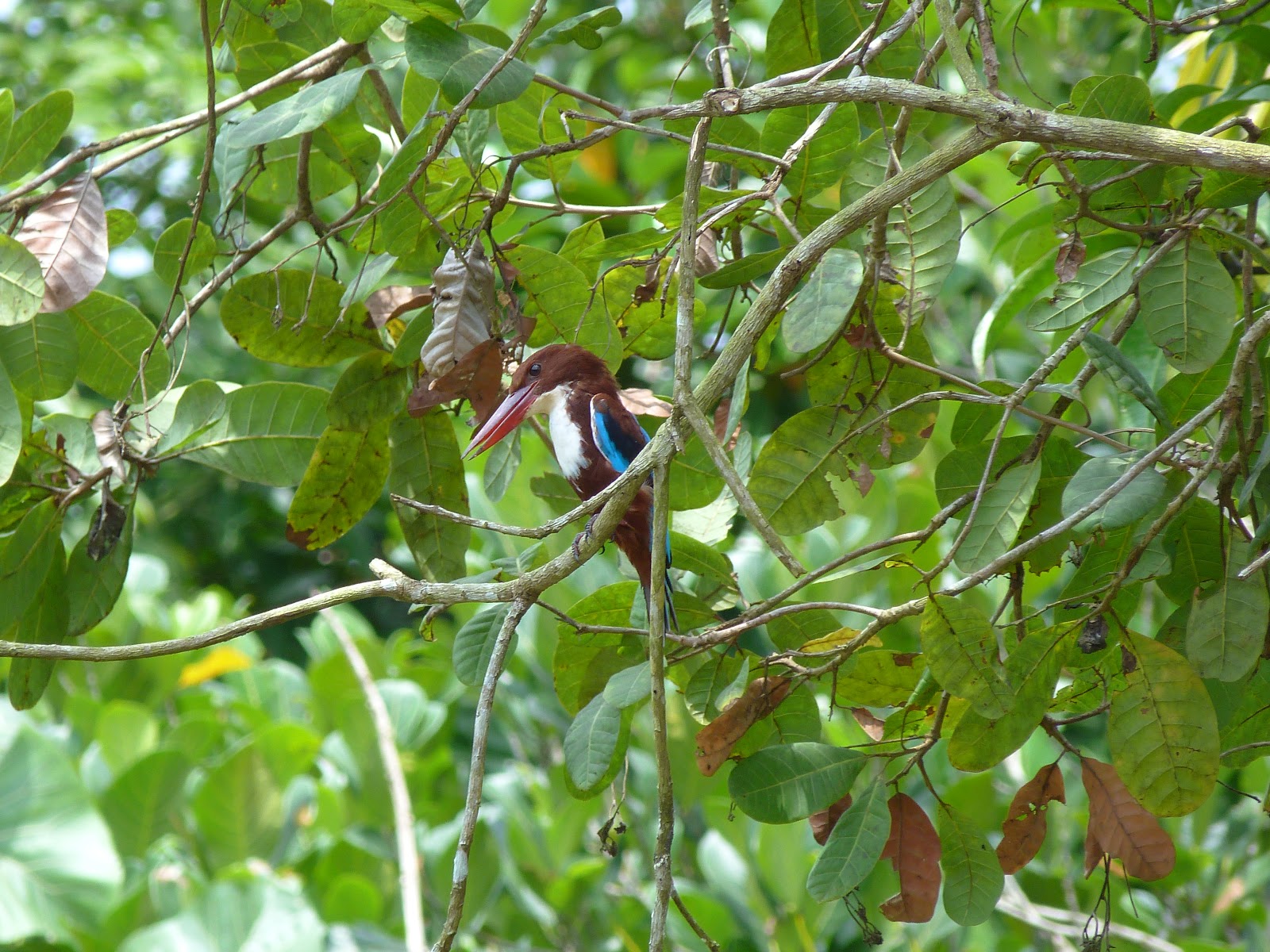
Since we bought this land in 2004 at Chettikad, we keep some space for the nature. One of these spots is the biotope behind the pond in the garden on the west of the house. We don‘t touch this wilderness in order to provide a place for all the living creatures here. Many of them we don‘t see as four turtles and the frogs in the water, but a variety of birds we can watch in the trees and along the pond as kingfisher, woodpecker, kakadu, uppan, hummingbird and many more, of course a lot of crows, which up in the sky chase krishna-eagles or other big birds away. 


Kingfishers come every day to catch small fish from Sylviander House pond. Once there were four of them in the same moment, once a couple made a nest at the shore. So we can spend hours sitting on the veranda without boredom. And of course there is a permanent concert made by these birds. 


In the morning sitting with hot tea on the morning tea veranda to the East, birds and butterflies in the cashew-nut tree are very active. In the night the sound of night-birds flies with our dreams and next morning we wake up with the voices of the birds and of the nearby sea. 


Kingfisher is sitting for hours on a dry branch waiting for the rain stops.


A very rare visitor! A friend of us who is an expert guessed: Shikra - Accipiter badius

Monday, 21 January 2013

Sun, Jan 20, 2013, 4pm: First Children Class


Since the opening of Sylviander House Art Museum on December 21, 2012 with Alexander‘s exhibition of paintings »Water, the Mirror of the World«, a lot of visitors came to see the paintings and installations. What really surprised us were the presence of enthusiastic children from our neighbourhood. Several of them came and again and brought other kids to see the work. Some of them also liked to play on the 100 year-old piano, we brought all the way from Germany which now has its own place in one corner of the Art Museum at Alappuzha. This incredible, unexpected enthusiasm and interest of the kids inspired us to develop an idea to start a dialogue with children from the village. When asked if they were interested in this project they all kids said "yes" and they smiled. We fixed the date for Sunday, January 20. 2013, 4 in the evening. The kids agreed to inform others as well.
On Sunday morning when Alexander was on his way to the village market he met many kids and parents who talked about the event in the afternoon. A boy came in the morning and one of the regular visitors   apologised for not being able to participate in the class, because his parents wanted to take him for a festival at the nearby church. The group of kids arrived before time, some with their school exercise books and pens. About 21 kids had turned up, in the age of 2 years upto 14 years along with two mothers, two artists. They joined Alexander, me and Dorothea, a German friend of ours staying at Sylviander House for three weeks photographing the landscape and people. Lila amma, who helps us keeping the house clean was curiously watching the gathering from the door entrance who told us next day morning how much she liked this event. After everybody told their names, name of their school and standard they study, the children were asked for their favorite painting of the exhibition. Mostly they liked the paintings »Mothertree« and »Kids laying and watching the rain«. 
Since the theme of the exhibition is "water", the topic of our first meeting was also - Water. What could be the reason the artist painted so many raindrops over his paintings? That makes the beauty, the kids answered. After a short introduction of Alexander, about the idea of such a gathering at the Art Museum, I spoke to them about the phenomenon of water in English while Alexander translating into Malayalam. 
How to say things in simple words to make children understand the complexity of water? Some already knew that a human body consists of 70-80% water. But none had ever heard of scientists examining water and being very astonished about the different results of their experiments. How is it possible? The scientists had put the water of the same source under their microscope. Then they understood, that water communicates. In their experiments it had reflected the actual mood of the person, who examined it. Being able to change any moment, water never remains same. That means, our body water is in resonance with every water in the outside even with raindrops, rivers and lakes, with the brooks and ponds as we have here a lot in Chettikad also. Nowadays all the ‘Pozhi‘, the small canals, and most of the ponds nearby are badly polluted with waste materials. What could this mean to the 80% water of our body? Probably the informative is sadness. Who wants to be sad? Nobody. Who wants to be happy? All hands were up.
Another interesting view of water‘s soul is the work of Emoto. The Japanese scientist developed a technique to take photographs of frozen water crystals. He takes water from different places like springs in the mountain or from rivers in big cities to make the differences visible. He also makes the energy of words visible by filling the same water in several bottles, each labeled with different words as love, thanks, hate, greed. Or he exposes the bottled water to loud noise or fine music… Photographed after one day, the pictures show it clearly. The water labeled with negative words or exposed to painful noise showed only very poor crystals or none like the water from big cities, but the water labeled with positive words or exposed to nice music created such beautiful rich crystals that everybody who sees the figures must love them. That means, every thought we have or every word we say to others or get to hear from others has an effect, can make the water of our body cells happy, sad or angry. With this awareness, it is easy to imagine the mood and constitution of the water in the landscapes of our surrounding.
With the promise to show the pictures of the water crystals of Emoto to the children next time to the gallery, we shifted our topic back to paintings, which were seen now with different eyes. After some questions and answers Dorothea played on her guitar and sang a water-song  »… all life comes from the sea …« to the gathering. Few of the children dared to join us with singing but all clapped their hands which showed their genuine enthusiasm. Three of them presented Sylvie with their drawings with the title - "For Sylvie Aunty!"
What a joy!
It seemed everybody wanted to continue with the session. So we fixed the date for the next one - Sunday February 17, 2013 at 4pm.
(Written by Sylvie Bantle)


Monday, 14 January 2013

Happy New 2013


… am letzten Tag des alten Jahres öffnet unser Lotus im Teich zum ersten Mal seine Blüte – auf ein Neues … 
… on the last day of the old year the lotus of our pond opens its bloom for the first time – for a good spirit in the new … 

HAPPY NEW YEAR TO EVERYBODY

Sylvie & Alexander